Beginner's Guide to Fragrance Composition
Learn the fundamentals of the fragrance pyramid, how top, heart, and base notes work together, and how to start your first composition.
The Fragrance Pyramid
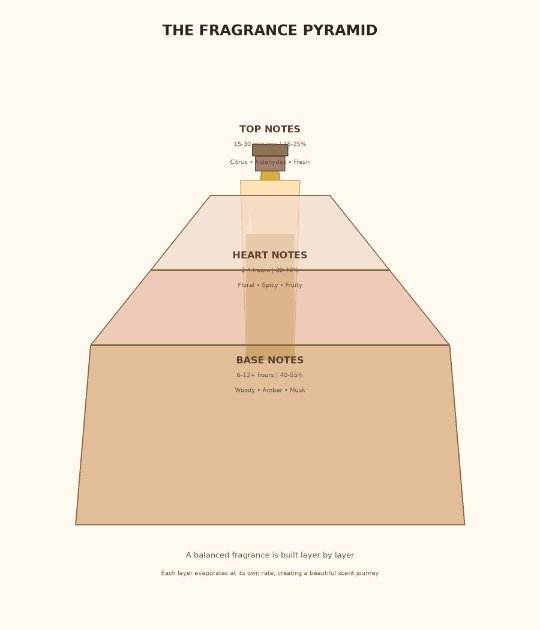
Every perfume is built on a three-tier structure called the fragrance pyramid. Understanding this structure is the first step to becoming a confident composer.
Top Notes — The First Impression
Top notes are what you smell the moment you spray a fragrance. They are light, volatile, and evaporate within 15–30 minutes. Common top notes include:
- Citrus: Bergamot, Lemon, Grapefruit
- Fresh: Aldehydes, Green leaves
- Spicy openers: Pink Pepper, Cardamom
Heart Notes — The Character
Heart notes emerge after the top notes fade. They define the fragrance's personality and last 2–4 hours. Popular heart notes include:
- Floral: Rose, Jasmine, Iris
- Spicy: Cinnamon, Saffron, Clove
- Fruity: Peach, Apple, Plum
Base Notes — The Foundation
Base notes are the deepest, richest layer. They anchor the fragrance and can last 6–12+ hours. Key base notes include:
- Woody: Sandalwood, Cedarwood, Oud
- Amber/Resin: Amber, Benzoin, Labdanum
- Musk: White Musk, Skin Musk
Concentration Ratios
A balanced composition typically uses:
- Top notes: 15–25% of total concentration
- Heart notes: 30–40%
- Base notes: 40–55%
These are guidelines, not rules. Experimentation is key.
Your First Composition
1. Pick a theme (fresh citrus, dark oriental, floral romantic) 2. Choose 2–3 top notes, 2–3 heart notes, and 2–3 base notes 3. Start with equal concentrations and adjust by feel 4. Use the AI analysis to understand how your blend reads 5. Iterate — great fragrances are refined, not born perfect